Choosing a donor bike
A "donor bike" is the bike you build the kit on. Choosing the right donor bike is crucial for both the outcome of the build and your safety. This guide helps you understand what to look for.
GBIKE sells electric conversion kits. Choosing the donor bike and judging whether it is stable enough for the kit is your responsibility as the builder. We provide guidelines here, but you must inspect and evaluate your specific bike.
Quick checklist
Before we go into detail, here is a quick overview of what you are looking for:
| Requirement | Why |
|---|---|
| 135 mm inside width at the rear dropout | The motor needs to fit |
| Standard open dropout, not thru-axle | The hub motor axle must fit |
| Strong brakes, preferably hydraulic disc brakes | Safety at high speeds |
| Strong frame without cracks or damage | Must withstand the load from the motor |
| Bottle cage mounts on the down tube | For the battery mount |
| Suspension (optional) | Recommended, but not required |
1. Rear dropout - Must fit the motor
The most important requirement is that the hub motor fits into the frame's rear dropouts.
Dropout width: 135 mm
The GBIKE 1 kit has a motor with 135 mm axle width. This is the standard size for most mountain bikes and hybrid bikes with quick release.
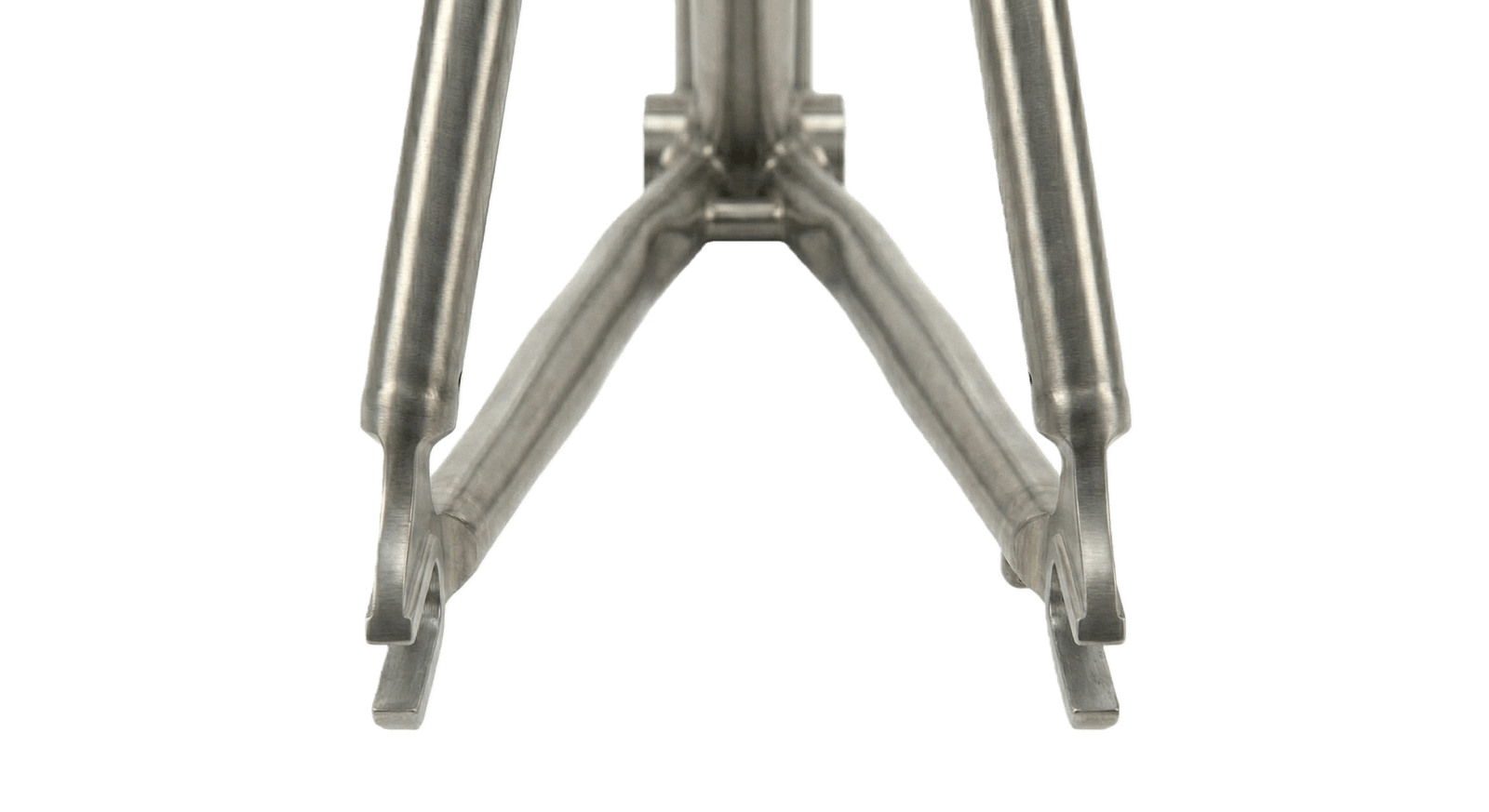
If you want to be completely sure of the size, measure it like this:
- Remove the rear wheel
- Measure the distance between the inside faces of the two dropout tabs
- The measurement should be 135 mm (or close enough)
If the measurement is a few millimeters too narrow, you can often gently spread the frame:
- Aluminum: Can be bent 3 to 5 mm with care
- Steel: Can be bent several centimeters without issue
- Carbon fiber: Cannot be bent. Choose another bike.
Dropout type: Standard open dropout
The hub motor requires an open dropout where the axle slides in from above or from behind. This is the classic design on most bikes.
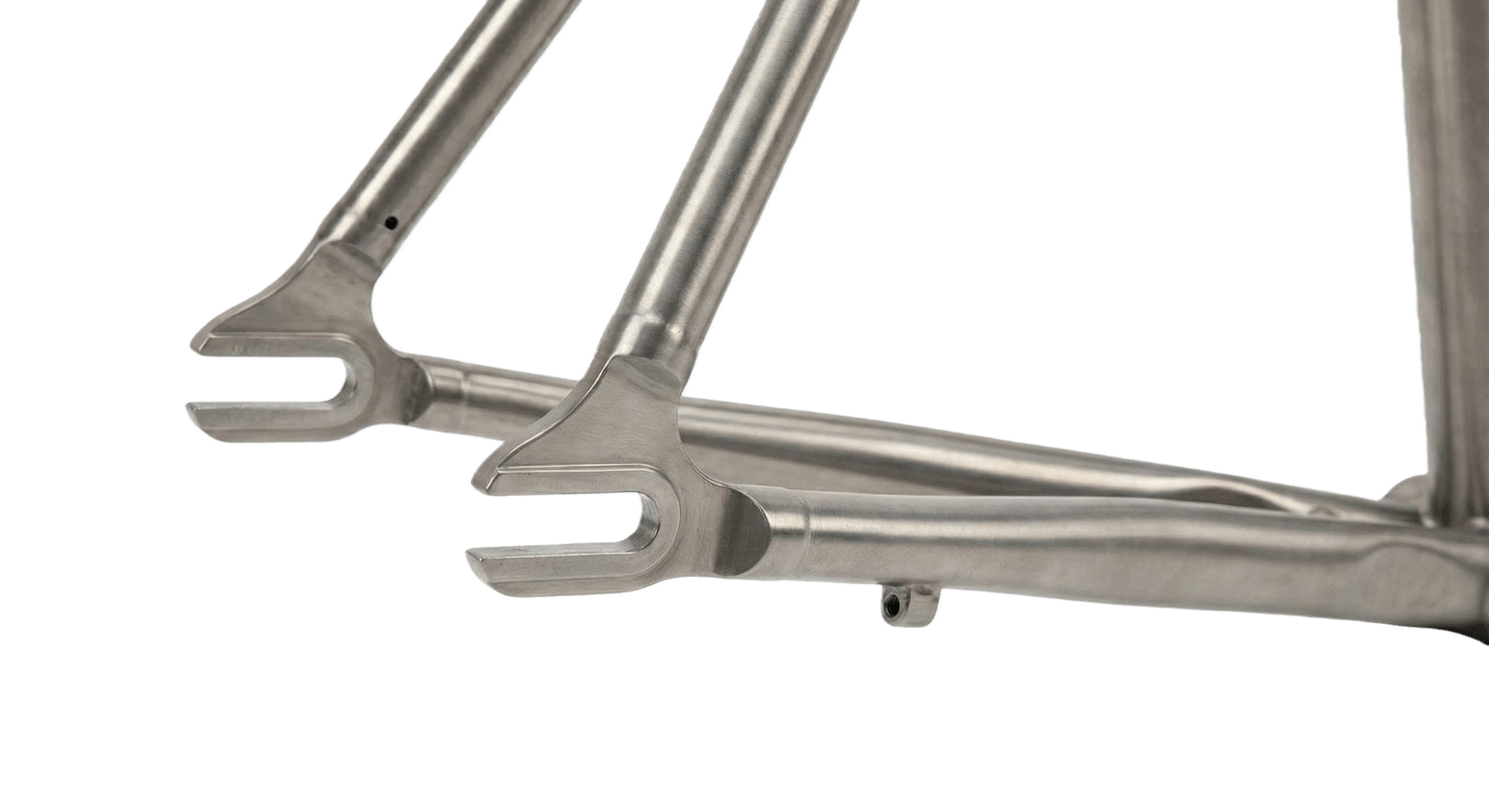
Will NOT work:
- Thru-axle. Common on modern downhill and gravel bikes.
- Internal hubs, such as Shimano Nexus with internal gear hub
Downhill bikes may seem perfect thanks to their robust construction and strong brakes. But many modern downhill bikes have thru-axle dropouts that are not compatible with our kits. Always check the dropout type!
2. Brakes - Safety at high speeds
With a motor kit that can reach 60+ km/h, the brakes become critically important.
Our recommendation: Hydraulic disc brakes
Hydraulic disc brakes are our strongest recommendation. They provide:
- Significantly better stopping power than mechanical alternatives
- Consistent braking performance in all weather
- Less maintenance and adjustment needed
If the bike has hydraulic disc brakes, it is probably good enough for a kit. Bikes with hydraulic disc brakes are generally built to a higher overall quality, which makes them suitable as donor bikes.
Other brake types
| Brake type | Suitability | Comment |
|---|---|---|
| Hydraulic disc brakes | Excellent | Best choice |
| Mechanical disc brakes | Marginal | Works, but needs regular adjustment |
| V-brakes (rim brakes) | Not recommended | Requires perfectly true rims, worse in rain |
| Coaster brakes | Avoid | Does not work |
3. Frame quality and stability
The frame is the foundation of the entire build. A damaged or too weak frame is a safety risk.
Inspect carefully
- Look for cracks. Especially at welds, the headset, and the dropouts.
- Check for dents. Dents in the tubes weaken the structure.
- Look for wear. Excessive wear may indicate abuse.
Frame materials
| Material | Advantages | Disadvantages |
|---|---|---|
| Steel (CrMo) | Extremely durable, can be bent without breaking, can be welded | Heavy, steel bikes often have V-brakes and narrower dropouts |
| Aluminum | Light, stiff, most mountain bikes | Hard to weld, harder to bend than steel |
| Carbon fiber | Very light | Avoid! Risk of hidden damage, cannot be bent |
Carbon fiber can have internal damage that is impossible to see with the naked eye. It also cannot be bent without cracking. We strongly recommend choosing a donor bike made of steel or aluminum.
4. Mounting the battery and controller
In addition to making sure the motor fits, you need places for the battery and controller.
Battery mount
The battery that comes with the GBIKE 1 kit is mounted with a mounting plate that screws into the frame's bottle cage mounts.
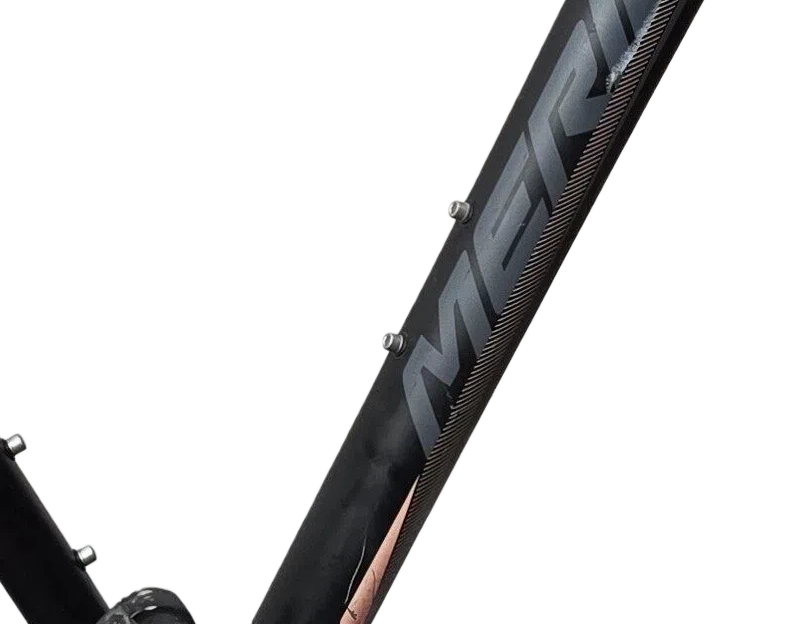
Most bikes have threaded holes for bottle cages on the down tube. The battery mount uses the same holes.
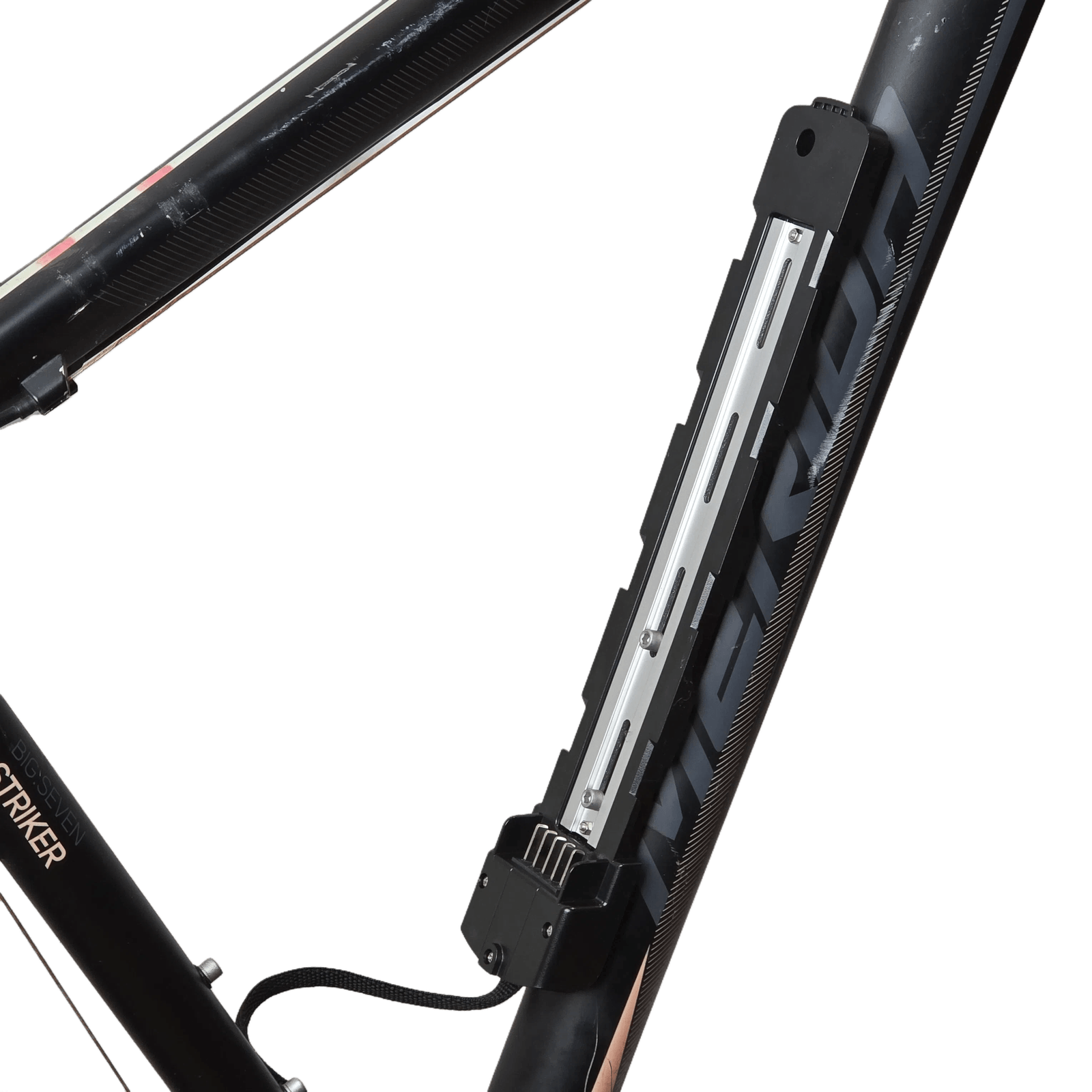
If your bike does not have bottle cage mounts, or if they are in an awkward position, you can still solve it with some creativity and zip ties/steel straps or external mounts. But the cleanest and safest solution is always frame mounting.
Controller mounting
The controller also needs a place on the bike. The ideal location is behind the battery in the frame triangle.
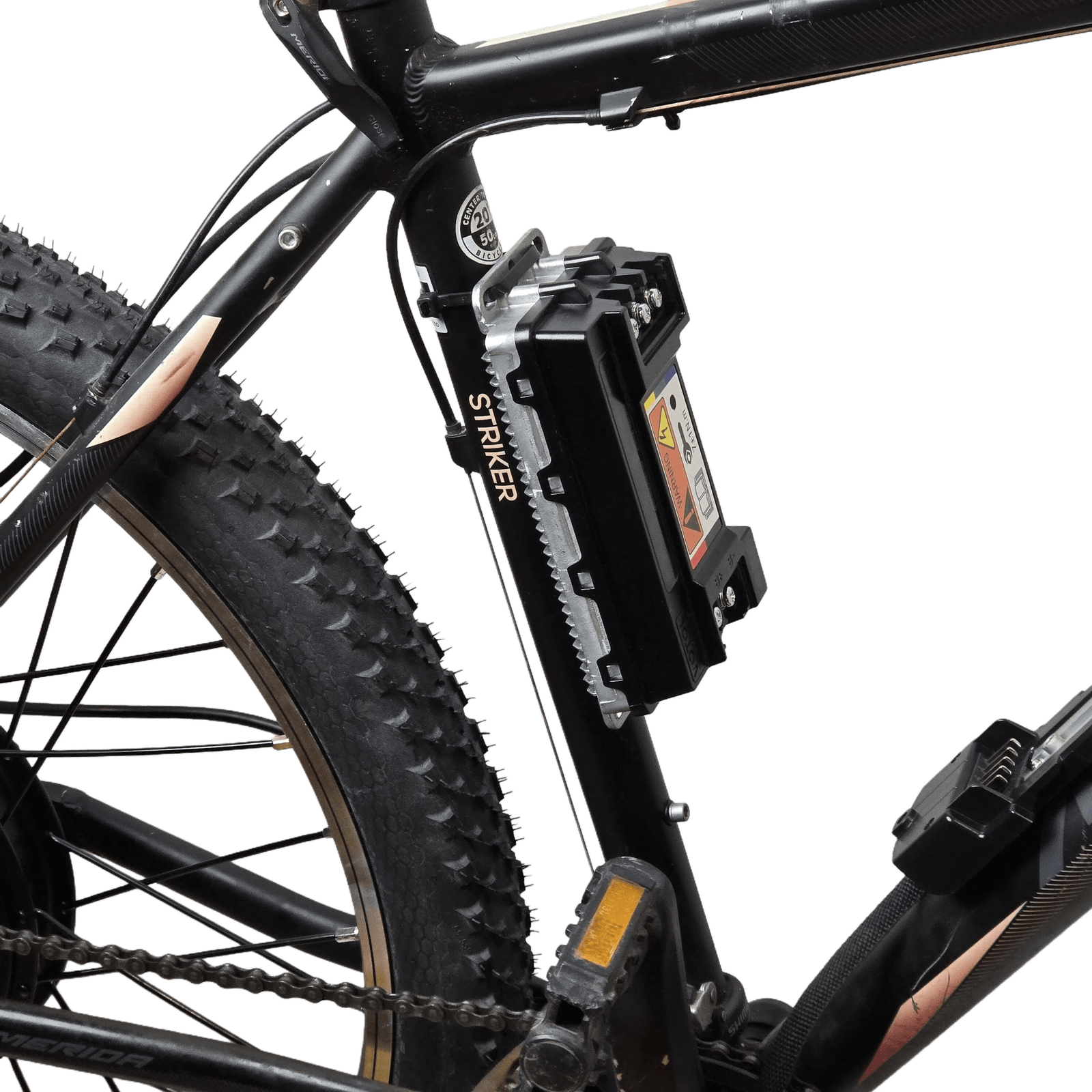
If the frame does not have enough room for the controller behind the battery, there are alternatives:
- Under the rear rack
- In a frame bag
- Under the saddle
Sometimes creativity is needed, but it can almost always be solved!
5. Suspension and comfort
Suspension is recommended
For GBIKE 1 we recommend a bike with a suspension fork. Reasons:
- Higher speeds make bumps more noticeable
- Better grip during acceleration
- More comfort on longer rides
Full suspension is even better for comfort and control, but not necessary.
A rigid fork works too
A rigid, unsuspended bike technically works, but you should expect a rougher ride at high speeds.
6. Where do I find a donor bike?
Used is the smartest choice
You do not need to buy new! A used mountain bike in good condition is often the best choice:
- Facebook Marketplace: Plenty of mountain bikes for 2500 to 4000 kr
- Blocket: Find one locally
- Bike shops: Some sell used or traded-in bikes
What should you look for?
- Mountain bikes from the 2010s and newer with hydraulic disc brakes
- Hybrid bikes with disc brakes (often 135 mm dropout)
- Older downhill bikes (but check thru-axle and space for battery mounting!)
Price guidelines
| Budget | What you can expect |
|---|---|
| 1000 to 2000 kr | Older mountain bike, maybe mechanical disc brakes or V-brakes |
| 2000 to 4000 kr | Good mountain bike with hydraulic disc brakes |
| 4000 to 6000 kr | Higher quality, possibly full suspension |
Common questions
Can I use my old bike?
Yes, if it meets the requirements above! Inspect it carefully for damage and wear.
Does wheel size matter?
GBIKE 1 comes with a hub motor mounted in a 26-inch rim. Your donor bike does not need to have 26-inch wheels, since you are replacing the rear wheel anyway. But the frame must have room for a 26-inch wheel, which most mountain bikes do.
Does the number of gears matter?
Short answer: Not really, because you will still need to get a new freewheel and often a new shifter for the motor wheel.
Longer explanation:
The hub motor replaces the entire rear wheel, including the hub where the gears sit. You therefore need a new freewheel (6 or 7 speed) for the motor wheel. These kits assume 6 or 7 rear gears.
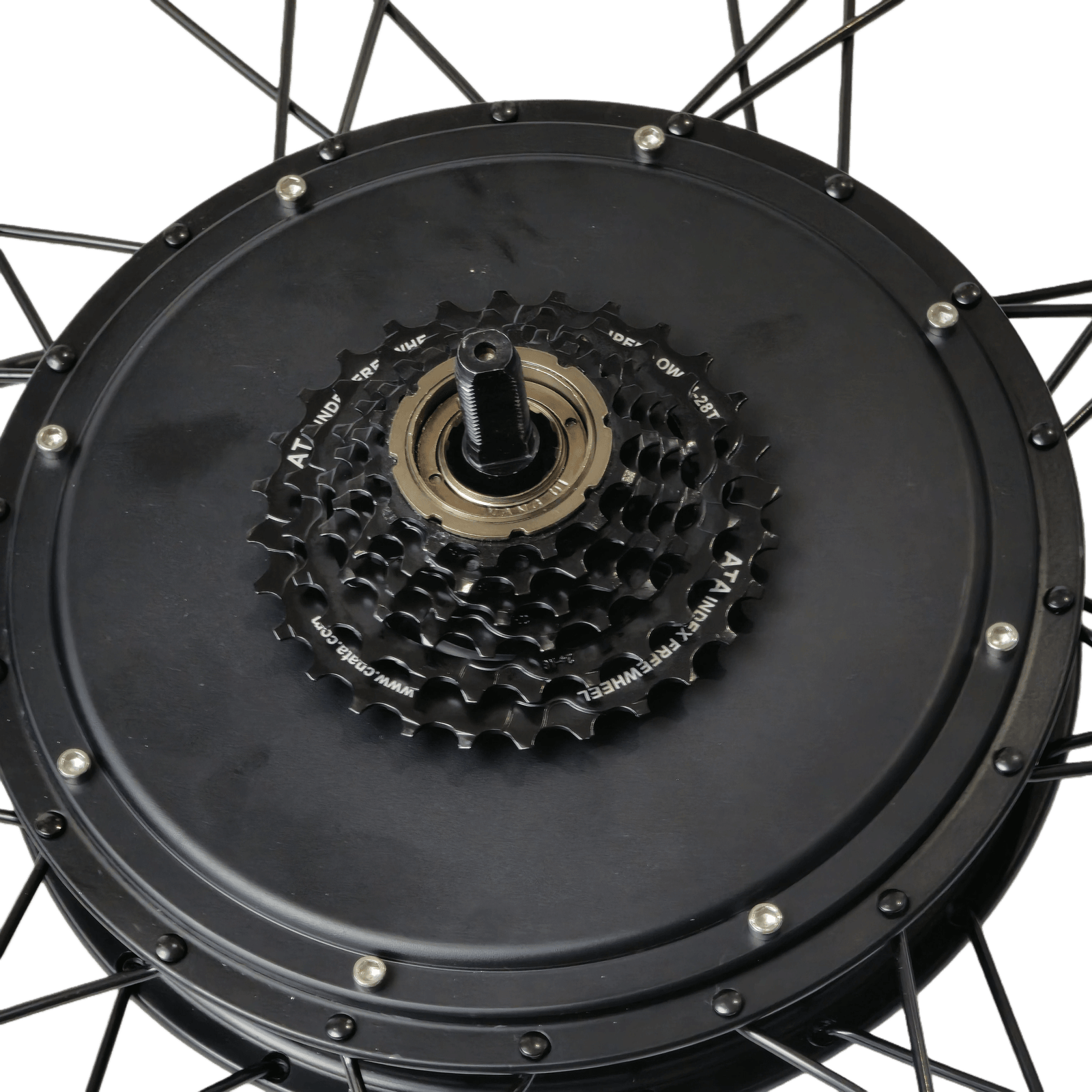
Can you reuse parts from your donor bike?
| Part | Reusable? | Comment |
|---|---|---|
| Freewheel | Sometimes | If the bike has 6 or 7 speeds and a freewheel, not a cassette, you can move it to the motor wheel |
| Cassette | No | Cassettes do not screw off in the same way. They cannot be used on the motor hub. |
| Shifter | Often | If the bike already has 6 or 7 speeds, you can usually keep the shifter |
| Rear derailleur | Yes | The rear derailleur is on the frame and works regardless |
- Freewheel: More common on older bikes. The entire cog cluster screws off as a unit with a special tool.
- Cassette: More common on newer bikes. The cogs slide onto a freehub body and are held in place with a lockring.
If you are unsure, look up your bike model or bring the wheel to a bike shop.
Summary:
- If the bike has 6 or 7 gears with a freewheel: You can probably reuse both the freewheel and the shifter.
- If the bike has a cassette (common on newer bikes): You need to buy a new freewheel, but you can keep the shifter if it is 6- or 7-speed.
- If the bike has more than 7 gears: You need to buy a new freewheel and possibly a new shifter (6 or 7 speed).
Either way, it always works to get new parts, so do not worry too much about this when choosing a donor bike!
Can I use a folding bike?
In general, we advise against it. Most folding bikes are not built for the load that a powerful motor kit creates.
Summary
| Good donor bike | Avoid |
|---|---|
| Mountain bike or hybrid | Road bikes |
| 135 mm rear dropout | Thru-axle |
| Hydraulic disc brakes | V-brakes (if you can choose) |
| Steel or aluminum | Carbon fiber |
| No cracks or damage | Visible defects |
| Bottle cage mounts | Bikes without mounting points |
Example build
Here is a real example of a successful GBIKE 1 build on a used Bianchi mountain bike bought on Facebook Marketplace for about 3000 kr:
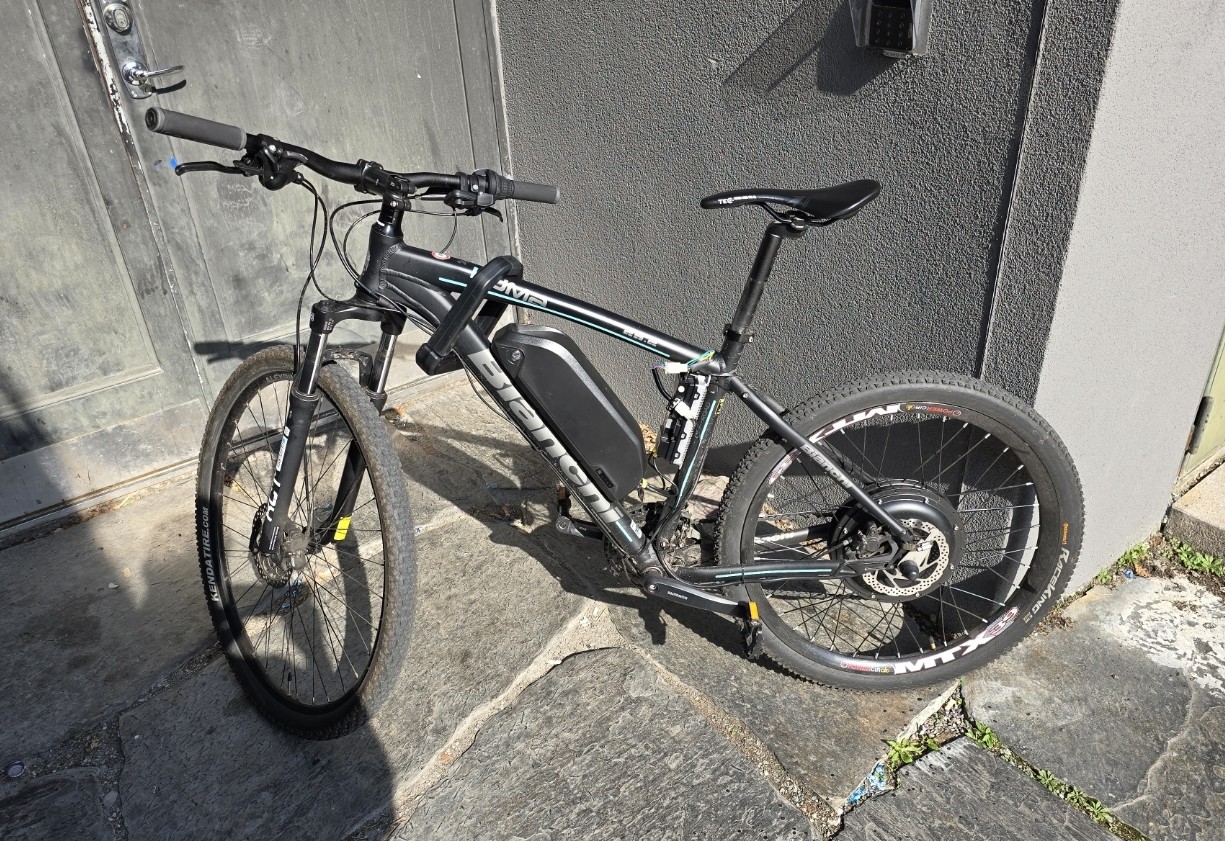
This bike had:
- Hydraulic disc brakes
- 135 mm dropout
- Bottle cage mounts for the battery
- Room for the controller behind the battery
- Suspension fork
A perfect donor bike at a good price!
Next step
When you have found your donor bike, you are ready to start assembling! Go to:
- GBIKE 1 Overview: Introduction to the kit
- Mechanical parts: Which extra parts you need
- Preparation and tools: What you need for the assembly